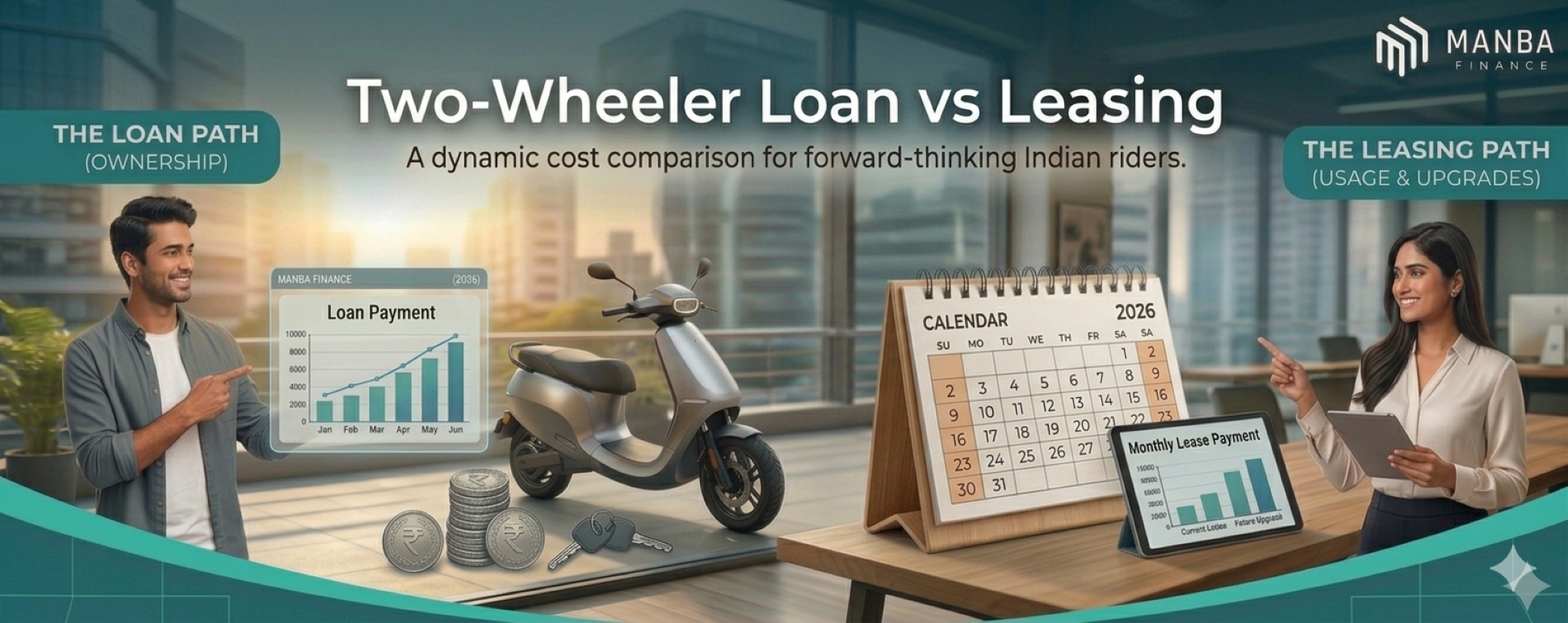
A two-wheeler loan is cheaper in the long run. With leasing, you pay every month indefinitely and own nothing at the end. With a loan, your EMIs stop once repayment is done and the bike is fully yours. For anyone planning to use their bike for 3 or more years, a loan wins on total cost
Here’s a question more people are asking in 2026: should I take a bike loan or just lease one?
It’s a fair question. Leasing is being marketed heavily right now with low upfront costs, no maintenance headaches, easy upgrades. Sounds appealing. But before you sign on the dotted line, it helps to understand what you’re actually paying for in each case and which option leaves more money in your pocket over time.
Let’s break it down properly.
What Is a Two-Wheeler Loan?
A two-wheeler loan is straightforward: a lender, a bank, NBFC, or a financing company like Manba Finance covers a large portion of your bike’s purchase cost. You repay this amount in monthly instalments (EMIs) over a fixed period, typically 12 to 48 months.
The bike is used as collateral during repayment, but once you’ve paid off the loan the vehicle is entirely yours. No more monthly payments. No conditions.
What this typically looks like in practice:
- Financing of 80–90% of the bike’s on-road price
- A down payment requirement (though this varies by lender)
- Fixed EMIs with a predetermined interest rate
- Full ownership transferred to you at the end of tenure
The key thing to remember: every rupee you pay in EMI is going toward owning an asset. That’s fundamentally different from leasing.
What Is Bike Leasing?
Leasing is essentially renting a bike for an extended period usually 1 to 3 years. You pay a fixed monthly amount to the leasing company, use the bike as agreed, and return it when the lease ends.
You never actually own the vehicle. The leasing company holds ownership throughout. At the end of the lease term, you typically have two choices: return the bike or upgrade to a newer model under a fresh lease agreement.
The simplest way to think about it:
Loan = You’re buying the bike, month by month.
Lease = You’re renting the bike, month by month.
Leasing charges you for the bike’s depreciation and usage during the lease period not for the vehicle itself. That’s why monthly lease payments often feel lower than EMIs. But that feeling can be misleading when you zoom out.
Loan vs Leasing: Side-by-Side Comparison
| Feature | Two-Wheeler Loan | Leasing |
| Ownership | Yours after full repayment | Stays with the leasing company |
| Upfront Cost | Down payment (varies by lender) | Usually low or zero |
| Monthly Payment | EMI towards ownership | Rental for usage only |
| What You Have at the End | A fully-owned vehicle | Nothing |
| Long-Term Value | Asset that holds resale value | No asset, no resale value |
| Flexibility | Fixed tenure, stable commitment | Easier to upgrade or switch |
| Total Cost Over Years | Lower (payments eventually stop) | Higher (payments never stop) |
Which Option Actually Saves More?
This is where most guides get vague. Let’s be direct.
If you take a loan:
You’ll pay EMIs for your chosen tenure, say, 24 or 36 months. Once that’s done, your financial obligation ends. The bike continues to serve you for years after that, cost-free (barring maintenance and fuel). If you ever want to sell it, you get resale value back.
A loan makes the most financial sense if:
- You plan to use the bike for 3 years or more
- You want to build a tangible asset
- You’d like to eventually resell the vehicle
- You want to establish or improve your credit history
If you lease:
Monthly payments feel manageable. You might spend less in month one, month two, month twelve. But at the end of year two or three? You hand the bike back and start again with nothing to show for the money you’ve paid. Then you’re back to monthly payments for the next lease.
Leasing makes more sense if:
- You genuinely use a vehicle for short durations and upgrade frequently
- Your lifestyle or profession requires you to switch vehicles often
- You have zero interest in ownership and the responsibilities that come with it
The bottom line is this: Leasing feels cheaper in the short term. A loan is cheaper in the long term because at some point, your payments stop. With leasing, they never do.
When Should You Choose a Bike Loan?
A bike loan is the right call for the majority of everyday riders, daily commuters, gig workers, salaried employees, and first-time buyers who want reliable, long-term transportation without an ongoing financial drain.
Choose a loan if you:
- Want to own your bike outright
- Plan to ride it for 3–5+ years
- Want to avoid indefinite monthly payments
- Are building your credit profile
- Prefer a structured, predictable repayment plan
The Manba Finance Advantage
Getting loan approval has traditionally been a hurdle for first-time buyers or those with non-traditional income gig workers, self-employed individuals, people with limited credit history.
Manba Finance approaches this differently. Eligibility is assessed based on real repayment ability and financial context, not just paper credentials. That means:
- First-time buyers don’t get automatically screened out
- Salaried and gig workers are evaluated on income actuals
- Flexible eligibility criteria means more people get to own their bikes
When Does Leasing Make Sense?
There are genuine use cases for leasing; it’s not all bad. If you’re a corporate professional who needs a vehicle for a 12-month project, or you prefer always riding the latest model and don’t want to deal with depreciation or resale, leasing offers that flexibility.
But go in with eyes open: you’re not building ownership. You’re not building equity. Every lease payment is a usage fee not a step toward anything you’ll own.
How to Apply for a Bike Loan with Manba Finance
Getting started takes about five minutes:
- Visit manbafinance.com and click “Apply Now”
- Fill in your personal and employment details
- Upload your documents Aadhaar, PAN, and income proof
- Receive a quick approval update
- Loan gets processed and your bike is yours
No long queues. No unnecessary paperwork. A process designed for real people with real lives.
Frequently Asked Questions
Is leasing cheaper than a bike loan?
In the very short term, leasing can feel cheaper because upfront costs are low and monthly payments may be slightly lower. But over a 3–5 year period, a loan is almost always more economical. Your payments stop once the loan is repaid, and you own an asset with resale value.
Do I own the bike if I lease it?
No. Ownership remains with the leasing company for the full duration. At the end, you return the bike or lease a new one.
Which is better for long-term savings?
A bike loan, if you plan to keep the vehicle for several years. Once the EMIs are done, you have a free asset. With leasing, payments continue indefinitely.
Is bike leasing available in India?
Yes, though it’s far less common than loan-based financing. Traditional two-wheeler loans remain the dominant and more accessible financing option.
Can I switch from leasing to owning midway?
Some providers allow a buyout option, but terms vary significantly. It’s worth confirming this before signing any lease agreement.
In Summary
Both options exist for a reason but they serve different kinds of people with different priorities.
If you want flexibility and don’t care about ownership, leasing has its place. But if you’re riding your bike daily, planning to use it for years, and want your money to actually go toward something you’ll own, a two-wheeler loan is the smarter, more economical choice.
The math is simple: loans end. Leases don’t.
Ready to take the next step? Check your eligibility at manbafinance.com and own your bike on your terms.