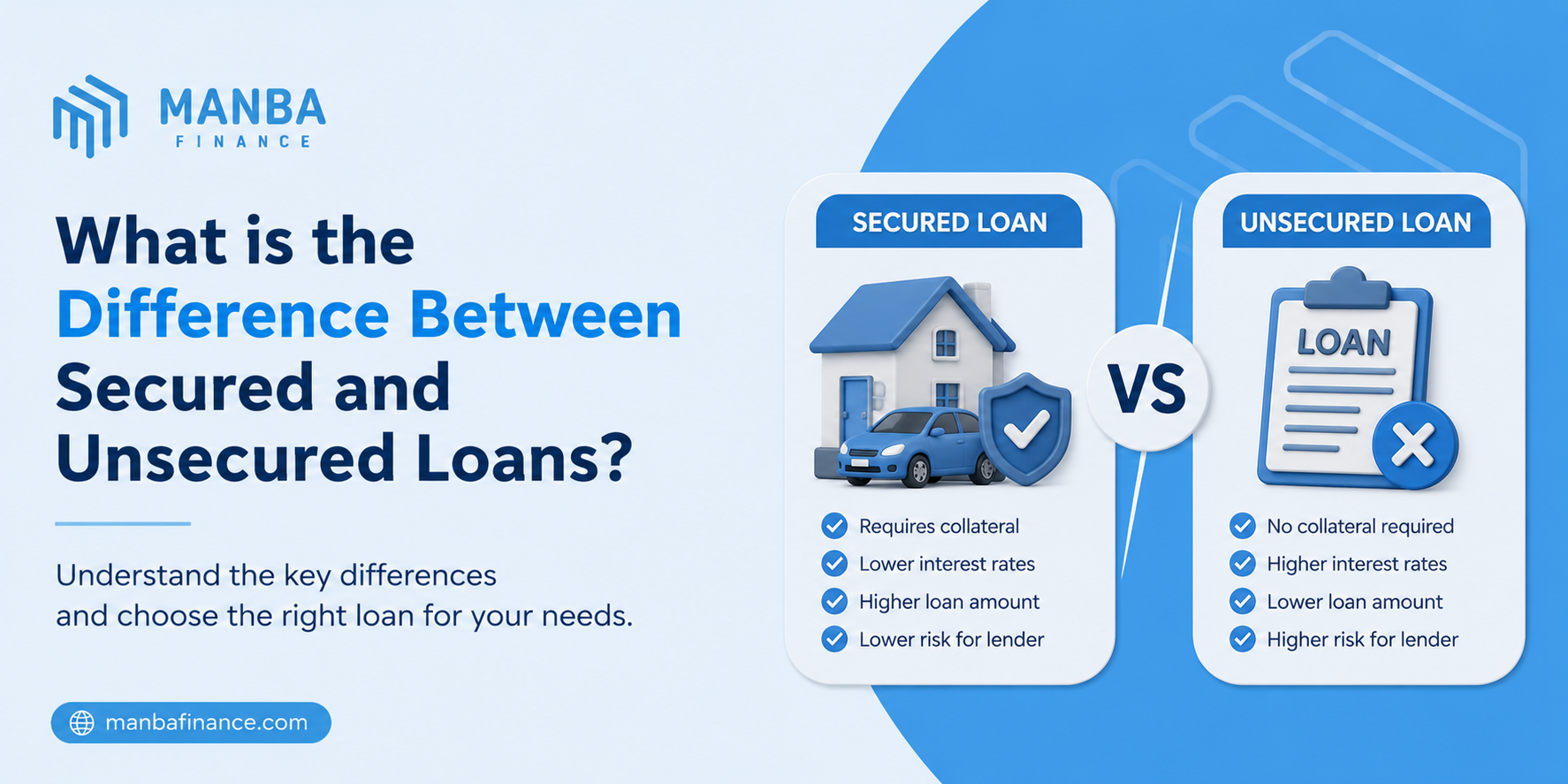
A secured loan requires collateral such as a vehicle, property, or fixed deposit, while an unsecured loan does not require any asset as security. Secured loans typically offer higher loan amounts and easier approvals, whereas unsecured loans rely heavily on the borrower’s income, credit history, and repayment capacity.
Introduction
Need ₹5 lakh by next week? The first question any lender is going to ask, in some form or another, is whether you’ve got something to put up against it: a car, a flat, gold, an FD. Your answer decides which side of the loan market you end up on.
Most lending in India splits cleanly along these lines. Home loans, vehicle loans, gold loans are all secured. Personal loans, business loans, credit cards unsecured. Why does it matter which bucket a loan falls into? Because it changes three things at once: how much you can actually borrow, how fast the approval comes through, and what happens to you if repayment stops going to plan.
What is a Secured Loan?
1. Definition of a Secured Loan
A secured loan comes with collateral attached. You pledge something of value, the lender gets a legal claim on it, and if you default, they can sell it to get their money back.
2. How Secured Loans Work
The lender values the asset and lends you a percentage of it the loan-to-value or LTV ratio. Because there’s something backing the loan, you’ll usually see lower interest and a longer repayment window than an unsecured loan would offer. Until it’s repaid in full, the lender holds a lien on the asset. That’s why you can’t just sell a financed car without the bank signing off first.
3. Common Examples of Secured Loans
A vehicle loan keeps the car or bike hypothecated to the lender till closure. Home loans work on the same logic, with the property itself mortgaged. Gold loans move fast, hand over the jewellery, walk out with cash, often within hours. And if you’ve got money parked in an FD you don’t want to break, a loan against it lets the bank simply mark a lien instead.
What is an Unsecured Loan?
1. Definition of an Unsecured Loan
No collateral here. The lender is going purely on your income, your credit history, and your track record of paying things back.
2. How Unsecured Loans Work
Without an asset as backup, lenders dig into your CIBIL score, income proof, job stability, and existing debt load. All that added risk on their end is usually why these loans cost more in interest and come with smaller amounts, shorter tenures, than secured ones.
3. Common Examples of Unsecured Loans
Personal loans are the obvious ones: weddings, travel, medical bills, anything, really approved of income and credit score alone. Business loans can be unsecured too, especially smaller working-capital amounts where the lender goes by financials rather than asking for property. A credit card is basically a revolving unsecured line. Consumer durable loans (the kind offered at the electronics counter for a new phone) sit here as well: quick, collateral-free, small ticket size.
Secured vs Unsecured Loans: Key Differences
| Factor | Secured Loan | Unsecured Loan |
| Collateral Requirement | Mandatory property, vehicle, gold, or FD | Not required |
| Approval Process | Asset valuation and legal checks; slower | Faster income and credit documents mainly |
| Loan Amount | Higher, tied to asset value | Lower, capped by income and credit profile |
| Risk for Borrower | Asset can be seized and sold on default | No asset at risk, but credit score drops and legal recovery is still possible |
| Risk for Lender | Lower asset recoverable | Higher nothing to fall back on |
| Eligibility Criteria | Asset ownership, reasonable credit history | Strong CIBIL score, steady income, low existing debt |
| Suitable For | Big, long-term needs home, vehicle | Shorter-term needs medical bills, travel, emergencies |
Which Loan is Easier to Get Approved?
Secured, by a fair margin. The asset does the heavy lifting. Even an average credit score gets a reasonable shot at approval once there’s property or gold behind it, because the lender isn’t relying on trust alone. Unsecured loans flip that entirely, means the decision rests almost completely on your CIBIL score, income, and how much you already owe elsewhere.
Income stability counts for a lot here, more so on the unsecured side, since a steady salary or business income is the only real signal the lender has. The CIBIL score matters just as much; 750+ is generally seen as strong, and for an unsecured loan it can end up being the deciding factor, full stop. Existing EMIs work against you too. A new unsecured loan gets harder to land once you’re already stretched thin, whereas a secured loan has the collateral absorbing some of that risk.
When Should You Choose a Secured Loan?
Buying something big like a house, a car and a secured loan is really the only practical way to borrow that much. It’s also the better pick if a lower interest rate and a longer tenure matter more to you than getting the money fast. Already sitting on gold or an FD? Borrowing against it can make more sense than liquidating it, as long as you’re confident about repaying on schedule.
When Should You Choose an Unsecured Loan?
Something unexpected comes up a medical bill, an emergency and unsecured is built for exactly that. Speed over size. It also works better if you’re running a business and don’t want personal or business assets exposed for short-term working capital. And for smaller goals such as a trip, a purchase, rolling a few debts into one EMI it’s usually just the more sensible route anyway.
Can You Get a Loan Without Collateral in India?
Yes, without much trouble. Most banks and NBFCs hand out unsecured loans personal, business, credit cards with zero collateral involved. What they’re checking instead: credit score, income, job or business stability, and existing debt.
In practice that means a minimum income, an age band roughly between 21 and 60, and some work history behind you. On paper, that’s a CIBIL score of 700 or above with no recent defaults, plus salary slips or ITR filings, bank statements, and the standard KYC documents.
Frequently Asked Questions
Is a bike loan secured or unsecured?
– Secured. The two-wheeler stays hypothecated until the loan’s closed.
Can I get a personal loan without collateral?
– Yes, that’s the entire premise of a personal loan.
Which loan type has higher approval chances?
– Secured. The collateral takes the pressure off your credit score in a way unsecured loans can’t replicate.
Do secured loans affect CIBIL scores?
– Same as any loan paid on time, your score benefits; miss payments, it drops, and you risk losing the asset on top of that.
Can self-employed individuals apply for unsecured loans?
– Yes, just expect more paperwork. ITR filings, business proof, bank statements lenders use these to judge repayment capacity without a salary slip to lean on.
Conclusion
Collateral is the dividing line. Everything else, loan amount, interest rate, approval speed follows from that one fact.
Got an asset you don’t mind tying up for a few years, and want the EMI manageable? Go secure. Need money fast and don’t want anything on the line? Unsecured gets you there, you just pay a bit more for the speed. Which one’s “right” really comes down to what you’re borrowing for, and what you’ve got to work with.
Explore our Personal Loan and Two-Wheeler Loan pages to check eligibility and apply.