1. Introduction: Why Your CIBIL Score Matters More Than Ever
It is the year 2026, and lending is now backed by data more than ever. The days when financial institutions relied on manual evaluation or tedious paperwork are behind us. Lenders can generate relevant data like financial behaviour, credit exposure, and repayment patterns within seconds, helping underwriters to analyse borrower profiles in detail.
Your CIBIL score plays a vital role during this process. A strong CIBIL score:
- Reinforces your financial standing
- Improves your chances for loan approval
- Boosts loan processing time
- Increases borrowing flexibility
Your credit profile is no longer just a number; it showcases your financial dependability and discipline to lenders. Your CIBIL score matters a lot nowadays, as it allows lenders to review your financial standing by gaining access to your previous and current loans, repayment patterns, and financial maturity.
2. What Exactly is a CIBIL Score?
A CIBIL score, issued by TransUnion CIBIL, India’s foremost credit information company, is a three-digit numeric summary of your creditworthiness. This score translates your financial behaviour into a risk score, as lenders can access it to review your financial profile. This is useful for financial institutions and also extends a credit line to borrowers. The CIBIL score provides a consolidated snapshot of how a borrower has managed their money in the past.
How is your CIBIL score generated?
Your CIBIL score is generated using data from banks, credit card issuers, NBFCs and other lending institutions. Every time you take a loan, use a credit card, make a payment, or miss a payment due date, an activity is reported, which becomes a part of your credit history. Using risk assessment models, historical data is processed to generate your score.
Why Do Lenders Depend on it?
In 2026, automation is helping lenders make lending decisions quickly and correctly. Nowadays, evaluating risks is a matter of seconds for Underwriting systems, and your CIBIL score is the primary filter. Your score provides lenders with answers to the following questions:
- Will you pay your EMIs or credit card bills on time?
- Is it risky to lend money to you?
- Are you responsible with your credit?
Lenders appreciate two values very much, predictability and discipline, and a higher score suggests exactly that.
3. What is Considered a Good CIBIL Score in 2026?
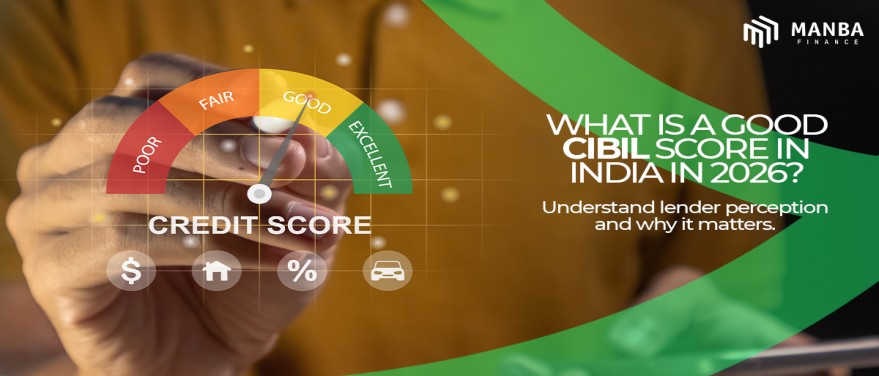
Instead of focussing on rigid numeric cutoffs, it will be more helpful to understand how lenders interpret various score ranges in 2026.
Excellent Score
- Quicker approvals
- Better flexibility in structuring loans
- Greater lender confidence
- Strong borrower profile
Good Score
- Stable credit profile
- Standard evaluation method
- Comfortable approval zone
Fair Score
- Needs further review
- Needs more scrutiny while underwriting
- May require stricter assessment or income verification
Low Score
- May need a collateral or guarantor
- Limited Options
- Above normal perceived lending risk
In 2026, it is not only about being “good” for the sake of eligibility; your profile should also be financially attractive to lenders.
4. Why “Good” is No Longer Just About Approval
In present times, a good CIBIL score does not merely work to qualify for a loan. It also decides the kind of experience you will receive. During earlier times, borrowers used to wonder,” Will I get approved?”. Now the focus is on “How strong is my negotiating position?” Modern lending is completely data-driven, segmented and competitive. Two applicants applying for a similar loan amount may receive vastly different offers- based purely on credit strength.
Let us understand how:
Quicker Approvals
Credit scores act as an instant risk filter for lenders, thanks to automated underwriting systems.
You can expect the following with a stronger CIBIL score:
- Faster loan processing
- Lesser manual scrutiny
- Reduced documentation
- High probability of across-the-table approvals
Salaried people and business professionals need speedy approvals, be it loans or credit cards. A good CIBIL score is the best way to get into the fast lane, as it places you in the “low-risk” zone.
Better Loan Structuring
Approval is merely the start of your journey. Loan structuring ensures overall comfort during the loan tenure. If you have strong credit, expect the following to happen:
- Receive flexible tenure options
- Tailored EMI structure
- Lesser processing hassles
- Higher approved loan amounts
Due to this flexibility, the loan becomes more affordable and helps you to plan your finances in a smart way.
Higher Negotiation Power
Most borrowers think loan tenures are rigid, while actually they are not. Lenders find your profile desirable when your credit profile is stable and shows repayment discipline. This helps you to negotiate strongly, choose tenures that match your cash flow, and possess the confidence to choose and compare loan offers. Stronger profiles help to choose strategically, rather than accept whatever is being offered.
Access to Premium products
You say goodbye to standard credit offers if your score is strong. You will find yourself eligible for:
- Pre-approved offers
- Premium credit card categories
- Organised financing options
- Consumer durable financing with easier terms
5. Minimum Score Expectations Across Loan Types
Risk profiles vary across different loan products, and lenders evaluate them accordingly. Let’s check them in out:
- Personal Loans: Due to their unsecured nature, lenders need steady credit behaviour and solid payment history, as this gives them approval confidence.
- Business Loans: Business cash flow and individual credit behaviour play a valuable role for self-employed borrowers when lenders review them. Repayment history and stability are key factors here.
- Consumer durable loans: Credit usage history that is responsible and stable helps process short-term loans more quickly.
- Two-wheeler/Four-wheeler loans: Asset-backed financing lowers risk, and lenders are comfortable offering loans to those with moderate scores, as long as income is stable.
Institutions like Manba Finance do not just look at scores; they evaluate various factors through structured underwriting and flexibility.
6. Factors That Define a Strong Credit Profile
A strong CIBIL score depends a lot on behavioural consistency, and the following key factors define it:
- Consistent repayments: Timely payment of EMIs is a sign of reliability. Hence, payment history remains the most influential factor.
- Balanced credit usage: Moderate usage of available credit shows financial control on the borrower’s part and signals restraint.
- Longer credit history: The longer your credit history, the more predictable your repayment capacity is.
- Limited hard inquiries: When there are frequent loan applications against your name, lenders look at it as a financial urgency or hunger for credit.
Lending companies love predictability. For them, an applicant with steady income, proper repayments, and measured credit use is ideal as it portrays low risk. Your credit score is the outcome of risk evaluation, and the lower the risk, the higher the lender’s confidence.
7. How Lenders View Your Score Today
Modern underwriting systems go beyond just the number. They assess much more than that.
They evaluate the following, too:
- Income stability
- Employment Continuity
- Current Financial Responsibilities
- Latest behavioural trends
- Repayment discipline
When two borrowers have the same score, the one who has better financial stability will get better loan structuring choices. In 2026, it is the context that matters as much as the CIBIL score itself.
8. Is It Possible to Get a Loan With a Lower Score?
Yes- it is possible in many cases and depends on a few factors.
A lower CIBIL score does not automatically lead to rejection. Modern lenders like Manba Finance have an evolved and holistic evaluation process that takes many other factors into consideration. Having said that, the score is important; it is one component out of many in a broader risk assessment framework.
The following factors can help your cause even if your score is low or moderate:
Employment Stability: Lenders recognize income reliability when your job history is consistent or you have steady business operations. Perceived risk is lower when one has a long employment tenure with the same organization or has sustained self-employment.
Banking Behaviour:
Lender confidence grows significantly when your bank balance shows:
- Positive monthly balances
- Zero cheque balances
- Steady salary or business credits
- Controlled expenses
Guarantor Support: Approval probability can increase by a few notches when there is a financially stable guarantor with a good credit profile, especially where unsecured products are offered.
Secured Borrowing: Lender’s risk is at its lowest when loans are backed by collateral (property, fixed deposits, vehicles). Secured credit products are ideal for borrowers who are in the process of rebuilding their credit profiles.
Lower current obligations: Lenders consider an application favourably when your existing EMI is manageable as compared to your income.
Modern financial institutions like Manba Finance have implemented underwriting models that do not just consider the score but also assess various stability indicators as well. They believe that responsible financial behaviour can often compensate for a lower score.
Key takeaway: A lower CIBIL score may reduce options, but it does not eliminate them completely.
9. How to Move From Average to Excellent
There are no shortcuts to enhancing your credit profile. Disciplined, structured financial behaviour over time is the only way to do it.
The following strategic steps can help you achieve your credit score goals:
- Pay before due dates: On-time or early payments are the most powerful improvement step towards excellence. Remember, consistency portrays reliability.
- Avoid overleveraging: Stay within available credit limits, as exhausting them can be damaging to your profile. Controlled usage of credit shows financial maturity.
- Monitor credit health: You can prevent unpleasant surprises through proactive monitoring of your credit. Make it a habit to review your credit health to identify reporting errors, check for any unauthorised activity and track progress.
- Borrow with purpose: Unplanned, impulsive credit applications weaken lender perception while strategic borrowing builds credibility. Choose wisely.
- Maintain older accounts: The longer your credit history, the more stable your profile. Strengthen your profile by keeping your older accounts alive and well-managed.
An average profile can move upwards within months if small behavioural changes are made in a consistent manner.
10. Common Myths About Good CIBIL Scores
Misinformation about key facts can often unknowingly push borrowers to make self-damaging decisions. It is time to demystify these myths and see the light:
Myth #1: Checking your credit score lowers it
When you check your own credit report, it is counted as a soft enquiry and does not have any impact on your CIBIL score.
Myth #2: Closing credit cards enhances your score
Closing old credit cards may negatively impact your credit score as it shortens your hard-earned credit history and also reduces your available credit.
Myth #3: Only defaulters have low CIBIL scores
Let’s not blame only defaults for low CIBIL. Credit scores can go down because of:
- Irregular payment patterns
- High credit consumption
- Recurrent loan applications
- Settled accounts
Myth #4 Income Alone Determines your score
Salary or business income is a criterion, but it is your credit behaviour that credit scores measure. A disciplined borrower with modest earnings may have a stronger credit profile than a high-earning borrower with erratic repayment history.
Now that these myths are busted, you can take informed and strategic financial decisions to boost your credit score.
11. How Often Should You Check Your Score in 2026?
One should regularly monitor the CIBIL score without any unnecessary anxiety. A smart and practical way to do it is as follows:
- Monitor your score closely, especially if rebuilding your profile
- Check once, maximum twice a year
- Before applying for a major loan, review it for sure
When you make periodic checks, you can easily identify discrepancies, make sure the report is accurate and most importantly, take strategic decisions before borrowing. Make credit awareness a preventive habit, not a reactive one during emergencies.
Conclusion: A Good Score is Financial Power
In 2026, a robust CIBIL score is more relevant than eligibility since a good score shows:
- Financial discipline
- Borrowing flexibility
- Negotiation power
- Long-term financial opportunity
- Access to better credit solutions
When you practice and implement healthy credit behaviour, it provides more choices, enhances approval confidence and powers your position during financial negotiations. Credit health maintenance is not merely about loans; it is about leverage, too.
“Maintain a strong credit profile and explore borrowing solutions with Manba Finance designed for financially responsible individuals.”